

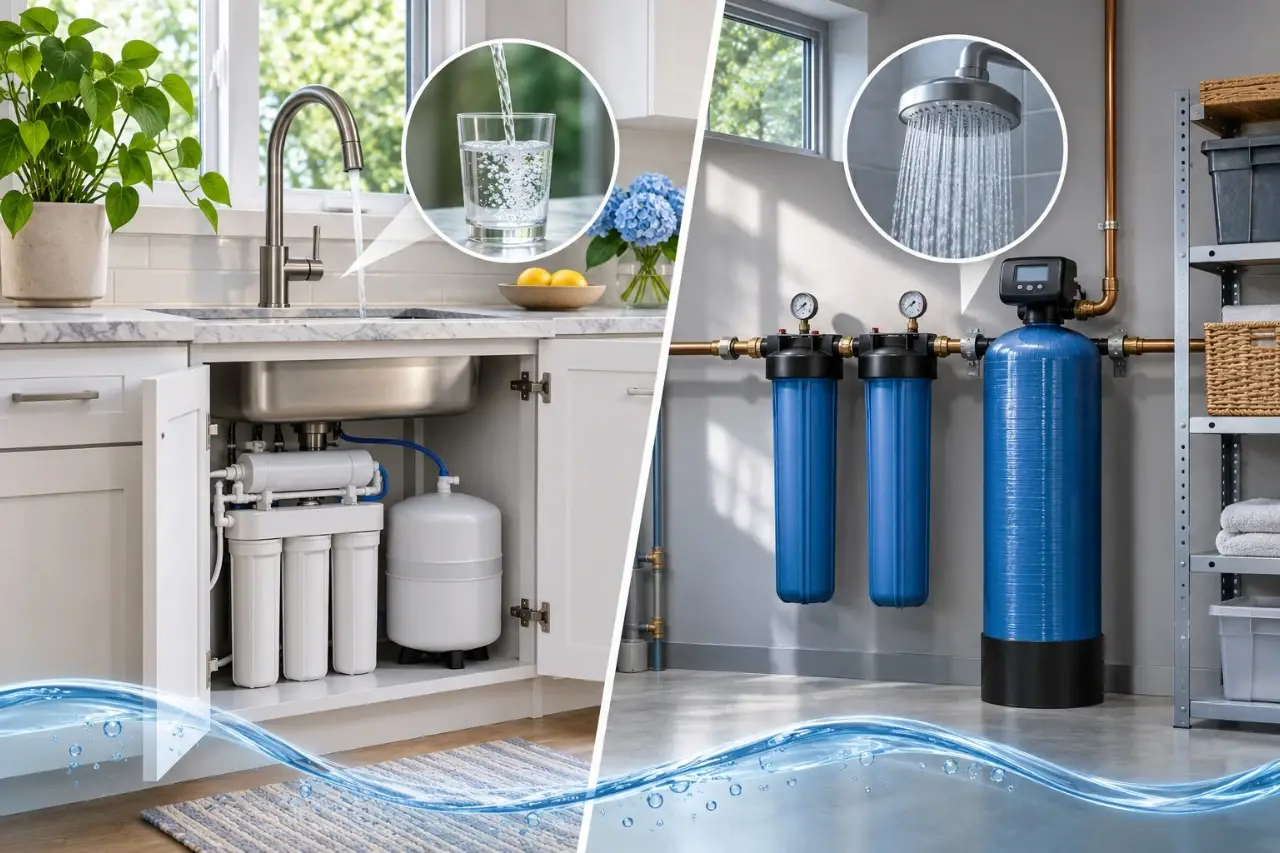
For most households, an under-sink filter is the right first buy when the concern is drinking and cooking water, and a whole-house system makes sense only when a problem shows up at every tap, shower, and appliance. The two systems are different coverage strategies. Neither one is a higher grade of safety than the other.
The choice comes down to two questions. Where in the house do you need treated water? Which contaminants does your water test show? A whole-house filter handles a lot of water but often a narrow set of problems. An under-sink reverse osmosis unit handles a small amount of water and a much wider set of contaminants.
Cost is where the wrong choice hurts. Whole-house treatment filters the water you flush, wash cars with, and pour on the lawn. That is a lot of water to pay for if your real goal is a cleaner glass at the kitchen sink.
You can decide with confidence once you know your test results, how much water your home uses at peak times, the space you have, and whether you own or rent.
What Are the Main Differences in Coverage and Performance?
An under-sink filter treats one faucet, while a whole-house filter treats every fixture downstream of the main line. That single difference drives flow rate, pressure loss, space needs, and how deep the filtering can go.
Under-Sink Filters Treat Water at One Faucet
An under-sink filter is a point-of-use (POU) system. It connects to the cold water line under one sink, most often the kitchen. Every other tap in the house keeps getting the same water it got before.
Under-sink units come in two broad types:
- Inline carbon filters tie into the existing cold line or feed a small dedicated faucet. They reduce chlorine taste and odor, and certified models also reduce lead and some chemicals.
- Reverse osmosis (RO) systems push water through a tight membrane, plus several pre- and post-filters. They reduce a much wider range of dissolved contaminants, including many metals, nitrate, and total dissolved solids.
Because the unit treats only a few gallons a day, it can use finer media and slower flow. That is why a small under-sink RO system can outperform a large whole-house carbon tank on the contaminants that affect drinking water.
One practical check: map which taps people use for drinking. If the fridge water and ice maker run on a separate line, they may sit outside the filter’s reach unless you route them through it.
Whole-House Systems Treat Water at the Main Supply
A whole-house system is a point-of-entry (POE) system. It sits on the main line after the shutoff valve, so showers, the washing machine, the water heater, and outdoor spigots all receive treated water.
Common setups include:
- A sediment filter for sand, grit, and rust flakes
- A carbon tank or cartridge for chlorine, chloramine (with the right carbon), and many organic chemicals
- Specialty media for iron, sulfur smell, or other well water issues
- Add-on stages such as UV for bacteria or a softener for hardness
A “whole-house” label only tells you where the filter sits. What it reduces depends on its media and its certification. Many basic whole-house carbon and sediment systems leave dissolved metals, nitrate, and PFAS largely untouched.
Whole-house treatment also stops at the filter. Lead or copper that dissolves from pipes and faucets after that point still reaches your glass.
How Do Flow Rate, Water Pressure, and Space Requirements Compare?
Flow is the biggest performance gap between the two. An under-sink filter only needs to keep up with one faucet. A whole-house system must keep up with your busiest moment, such as two showers, a dishwasher, and a running toilet at once.
| Factor | Under-Sink | Whole-House |
|---|---|---|
| Coverage | One faucet | Every fixture |
| Installed cost | $170–$580 | $850–$5,400 |
| Yearly filters | $20–$100 | $150–$250 |
| Pressure impact | One tap only | Whole home |
| Space needed | Sink cabinet | Utility area near main |
| Renter-friendly | Often yes | Rarely |
Some practical sizing tips from the field:
- Size whole-house units to peak demand. Check the system’s rated gallons per minute against the number of bathrooms and appliances that can run together. An undersized filter makes every shower feel weak.
- Bigger housings drop less pressure. The wider 4.5-inch cartridge housings hold more media than slim 2.5-inch ones and restrict flow less.
- Measure your pressure first. A cheap gauge on a hose bib tells you whether you have room to lose a few PSI.
- Plan the space. An RO tank and filters fill much of a kitchen sink cabinet. A whole-house system needs wall space, shutoff valves, a bypass, and access for cartridge changes.
Which System Addresses Your Water Quality Problems?
The system that fits is the one whose certified reductions match what is in your water at the taps you use. Testing tells you the target, and the filter’s technology and certification tell you whether it can hit that target.
Start With Your Water Report or a Targeted Water Test
If you are on city water, your utility must publish an annual Consumer Confidence Report. It lists what was detected and at what levels, and it costs nothing. Look for lead, PFAS, nitrate, disinfection byproducts, and whether the utility uses chlorine or chloramine.
The utility report has two blind spots. It reflects water leaving the treatment plant and sample sites, so it cannot show lead from your own service line or older solder. It also says nothing about hardness at your faucet in a useful way for sizing a softener.
Private well owners get no report at all. A certified lab test is the only reliable starting point, and a lab panel for a home runs $100 to $300 depending on how many contaminants you test for. For lead, test water from the kitchen tap after it sits overnight, since that sample catches what your plumbing adds.
Match Filtration Technology to the Contaminants You Want to Reduce
Each technology handles a different group of problems. This chart covers the most common household concerns:
| Problem | Technology that addresses it |
|---|---|
| Chlorine taste and smell | Activated carbon (POU or POE) |
| Chloramine | Catalytic carbon |
| Sand, grit, rust | Sediment filter ahead of other stages |
| Disinfection byproducts, VOCs | Activated carbon |
| Lead at the tap | Certified carbon block or RO at the faucet |
| Nitrate, arsenic, most dissolved solids | Reverse osmosis |
| PFAS | Certified RO or certified carbon |
| Iron, sulfur smell | Oxidizing media or specialty whole-house filters |
| Bacteria on a well | UV disinfection |
| Hardness | Water softener |
Carbon handles taste, odor, and many chemicals well, at the main line or the sink. RO reaches further into dissolved contaminants, which is why it lives under the sink. Treating a whole house with RO is possible, but it costs far more and produces much more wastewater.
Why Hardness and Microbial Contamination Need Specific Treatments
Hardness comes from dissolved calcium and magnesium. Sediment and carbon filters let those minerals pass straight through, so a standard whole-house filter leaves scale, spotty dishes, and poor soap lather unchanged. A water softener, which swaps hardness minerals through ion exchange, is the equipment that handles it.
Microbes need their own treatment too. Carbon and sediment filters are not disinfection devices, and a carbon bed can even become a place for bacteria to grow. If a well test shows coliform bacteria, the usual fix is shock chlorination, then a UV unit sized to the home’s flow rate, with sediment filtration ahead of it so particles do not shade the bulb.
Corrosion is a third gap. A whole-house filter does not stop aggressive water from eating at copper or lead plumbing. Low pH or corrosive water calls for neutralizing treatment, and lead from fixtures still needs a certified filter at the tap.
Check Certified Reduction Claims Rather Than Coverage Alone
Two filters with similar housings can have very different abilities. The way to tell them apart is third-party certification to NSF/ANSI standards for the exact contaminant you care about.
- NSF/ANSI 42 covers aesthetic claims such as chlorine taste and odor.
- NSF/ANSI 53 covers health-related claims, including lead and certain chemicals.
- NSF/ANSI 58 covers reverse osmosis systems.
- NSF/ANSI 55 covers UV systems.
- NSF/ANSI 401 covers emerging contaminants, and P473 has been used for PFOA and PFOS.
Read the claim, not just the logo. A filter certified to Standard 42 for chlorine has made no claim about lead. Also check the rated capacity in gallons, since a cartridge certified for lead only meets that claim within its rated life.
How Do Purchase, Installation, and Maintenance Costs Compare?
An under-sink system costs a fraction of a whole-house setup in both first-year and yearly costs. The figures below assume a typical single-family home on city water with a contractor handling the install, unless noted.
Compare Equipment Prices and Installation Expenses
Installed, a whole-house filtration system runs $850 to $5,400, and an under-sink filter runs $170 to $580. The wide whole-house range reflects how many stages you add.
| System | Typical installed cost |
|---|---|
| Under-sink carbon | $180–$550 |
| Under-sink RO | $300–$950 |
| Whole-house carbon, mineral, sediment | $850–$1,400 |
| Whole-house with UV | $1,850–$2,900 |
| Whole-house with UV and softener | $2,650–$5,400 |
| Whole-house RO | $4,800–$8,000 |
Labor is a big piece of whole-house cost. Plumbers charge about $45 to $200 per hour, and a whole-home filtration install lands around $300 to $600 in labor. Under-sink labor is lower, roughly $120 to $330.
First-year totals, including filters, run about $190 to $680 for under-sink and $1,000 to $5,650 for whole-house.
Account for Replacement Filters, Service, and RO Wastewater
Cartridges are the running cost that buyers forget to price. Replacement filters average $150 to $250 a year for whole-house systems and $20 to $100 for under-sink units, assuming you change them yourself.
Some practical points we suggest checking before you buy:
- Price the cartridges first. Look up the exact replacement part and its cost before choosing a model.
- Compare gallons per cartridge. Whole-house cartridges cover far more water, so judge cost by capacity, not by months between changes.
- RO has several stages. Pre-filters, the membrane, and the post-filter each have their own schedule.
- RO sends water to the drain. The membrane flushes away concentrated water as it works. Newer, more efficient units send less, so check the model’s efficiency rating.
- Softeners use salt. If hardness is part of the plan, budget $10 to $20 a month for salt.
- Change filters on time. A clogged cartridge keeps cutting your pressure after it stops filtering well.
Whole-house setups with backwashing media or RO also need a drain. Adding a new drain line to the sewer costs $300 to $800 extra.
Consider DIY Installation, Plumbing Changes, and Rental Restrictions
Most under-sink filters are a reasonable DIY job. Inline carbon units often install in under an hour with push-fit fittings. RO units take longer because they need a drain saddle and sometimes a hole in the sink or countertop for the faucet.
Whole-house installs mean cutting into the main supply line, adding shutoff valves and a bypass, and sometimes bonding the cut pipe for electrical grounding. Most homeowners hire a licensed plumber, and some towns require a permit.
Renters face a clearer limit. An under-sink filter that taps the existing cold line can come out cleanly when you move, but get written permission from your landlord first, especially if it needs a drilled hole. A main-line system changes the building’s plumbing, so it is rarely an option without the owner’s approval.
Should You Choose an Under-Sink Filter, Whole-House Treatment, or Both?
Start with the smallest system that solves your tested problem at the taps where it matters. Add a second system only when it has a separate, clearly stated job.
Choose Under-Sink Filtration for Targeted Drinking and Cooking Water Needs
An under-sink filter fits best when your water is fine for bathing and laundry, and your concern is what you drink and cook with. Common examples:
- Chlorine taste at the kitchen tap
- Lead from older faucets or service lines
- PFAS, nitrate, or arsenic flagged in your report or test
- A rental where you cannot alter the main line
For a taste complaint, a certified carbon filter is usually enough. For lead, look for NSF/ANSI 53 certification for lead. For nitrate, arsenic, or a broad list of dissolved contaminants, an RO system certified to NSF/ANSI 58 is the stronger fit.
Choose Whole-House Treatment for Problems Across Multiple Fixtures
Whole-house treatment earns its cost when a problem shows up everywhere. Good reasons include:
- Sand or grit clogging aerators, showerheads, and appliance valves
- Strong chlorine or chloramine smell in showers
- Rotten-egg sulfur smell or orange iron stains on fixtures and laundry
- Bacteria in a private well, treated with UV
- Hard water scale throughout the house, treated with a softener
Size the system to your peak flow. Then confirm each stage is certified or proven for the problem your test found, since a sediment stage does nothing for sulfur and a carbon stage does nothing for hardness.
Combine Systems When Drinking Water Needs Additional Treatment
Running both makes sense when each one handles a different job. A well home might use a whole-house sediment filter and UV for the whole house, with under-sink RO for nitrate at the kitchen tap. A city home might use a whole-house carbon filter for chloramine in showers and a lead-certified filter at the sink for older plumbing.
A sediment pre-filter at the main line also takes particle load off an RO membrane, which can help it last longer.
Be wary of bundles where two stages do the same work. Two carbon filters in a row add cartridge costs and pressure loss with little gain. Ask the installer what the second system changes and how you would verify that change with a follow-up test.
Match Your Filter to Your Water Test and Required Coverage
Pick the system that treats the contaminants your test found, at the taps where you need them treated, and stop there. For most city homes, that means an under-sink carbon or RO filter at the kitchen sink.
Whole-house treatment is the right call when sediment, chlorine smell, iron, sulfur, well bacteria, or hardness affects every fixture. Remember what it leaves alone: a standard whole-house filter does not soften water, disinfect it, stop pipe corrosion, or remove lead added after the filter.
Before you buy, gather four things:
- Your Consumer Confidence Report or a lab test, including an overnight kitchen tap sample if lead is a concern
- Your peak flow needs and current water pressure
- Measurements of your sink cabinet or utility space
- Your lease terms if you rent
Then match certified claims to each problem, price a year of replacement cartridges, and retest after installation to confirm the system is doing its job.
Frequently Asked Questions
What are the disadvantages of an under-sink water filter?
The main drawback is coverage, since it treats only the one faucet it connects to. Showers, bathroom sinks, and appliances still get untreated water. RO models also take up cabinet space, fill slowly, and send some water to the drain.
Can I drink tap water after installing a whole-house filter?
If your water was safe to drink before, it stays safe, and it may taste better with chlorine reduced. A whole-house filter makes drinking water safer only for contaminants it is certified to reduce. Lead from faucets and pipes after the filter can still reach your glass.
Does an under-sink filter remove lead introduced by household plumbing?
Yes, if it is certified to NSF/ANSI 53 for lead or is a certified RO system. Because it sits right at the tap, it catches lead picked up from pipes, solder, and fixtures upstream. Change the cartridge within its rated capacity to keep that protection.
Will a whole-house water filter soften hard water?
No, standard sediment and carbon filters let calcium and magnesium pass through. Hard water needs a water softener, which uses ion exchange to remove those minerals. Many homes run a softener alongside a whole-house filter when tests show both needs.
Is reverse osmosis healthier than whole-house filtration?
RO reduces more contaminants, such as nitrate, arsenic, and many metals, so it is the stronger choice when tests show those problems in drinking water. If your water only has a chlorine taste issue, RO adds cost and wastewater without a clear benefit. Base the choice on your test results and certified claims.