
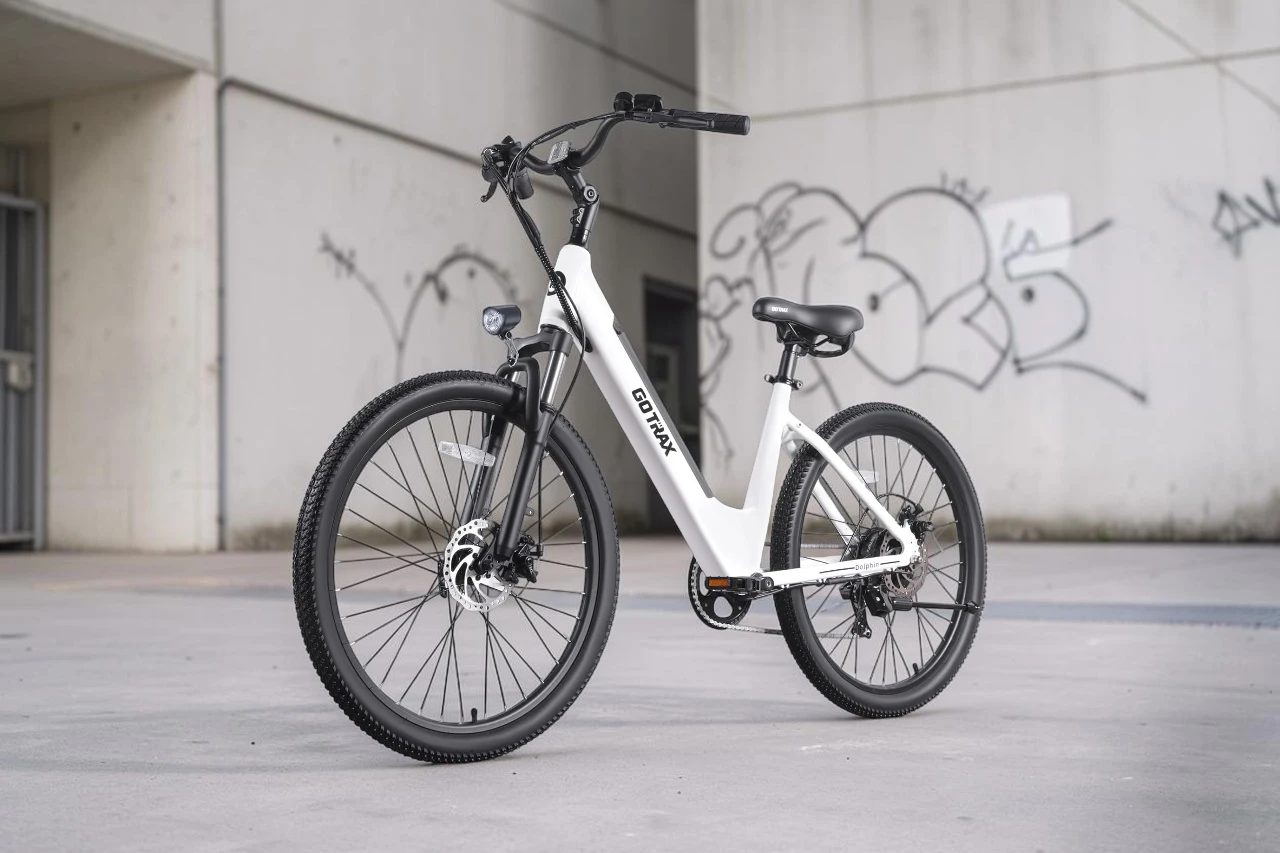
The Gotrax Dolphin 26-Inch Electric Bike is the kind of electric bike that reminds me why I enjoy riding e-bikes in the first place. It isn’t trying to be the fastest, most powerful, or most advanced bike on the market. Instead, it focuses on making everyday riding easier, whether I’m running errands, cruising through my neighborhood, or enjoying a relaxing weekend ride.
With a 350W motor rated at 500W peak, a removable 280.8Wh battery, five levels of pedal assist, and a comfortable step-through frame, the Dolphin offers a straightforward approach to electric transportation.
I’ve spent time riding it around neighborhood streets, paved paths, and slightly rougher roads. What stands out most isn’t any single feature. It’s how approachable the entire bike feels.
The controls are easy to understand, the motor delivers smooth assistance, and the riding position makes casual trips enjoyable without requiring much adjustment.
Of course, there are compromises. The battery is relatively small, the bike isn’t particularly lightweight, and the motor isn’t designed for aggressive climbing or off-road adventures.
So, is the Gotrax Dolphin worth buying?
Here’s what I’ve learned about its performance, comfort, battery life, braking, and everyday usability.
Quick Verdict: Is the Gotrax Dolphin Worth It?
Yes, the Gotrax Dolphin is worth considering if you want an approachable electric city bike for neighborhood riding, short commutes, and recreational cycling.
Its biggest strengths are its comfortable step-through design, predictable motor assistance, removable battery, and uncomplicated controls.
During my rides, I appreciated how naturally it fit into everyday activities. I didn’t need to plan an entire cycling adventure to enjoy it. Sometimes, a quick trip around the neighborhood was enough.
The motor provides sufficient assistance for ordinary roads and modest inclines, while the seven-speed drivetrain makes it practical to pedal without relying entirely on electricity.
However, I wouldn’t recommend it to someone who regularly rides steep hills, needs a long-range commuter, or has to carry a bike upstairs every day.
For its intended purpose, the Dolphin delivers a comfortable and refreshingly simple experience.
Best for: Casual commuters, recreational riders, neighborhood errands, paved bike paths
Not ideal for: Steep hills, demanding off-road riding, long-distance commuting, frequent stair carrying

Gotrax Dolphin Electric Bike Specifications
Here is a closer look at the Dolphin’s key specifications.
| Specification | Details |
|---|---|
| Bike type | 26-inch step-through city e-bike |
| Motor | 350W rated, 500W peak |
| Maximum assisted speed | 20 mph |
| Battery | 36V 7.8Ah removable lithium-ion |
| Battery capacity | 280.8Wh |
| Claimed throttle-only range | Up to 15.5 miles |
| Claimed pedal-assist range | Up to 30 miles |
| Charging time | Approximately 5–6 hours |
| Pedal assist | 5 levels |
| Riding modes | Throttle, pedal assist, manual |
| Drivetrain | Shimano 7-speed |
| Throttle | Thumb throttle |
| Brakes | Front and rear mechanical disc brakes |
| Suspension | Front suspension fork |
| Wheels | 26 inches |
| Frame | Step-through aluminum |
| Weight | Approximately 49–50 lbs |
| Maximum load | Approximately 264 lbs |
| Walk-assist | 3.7 mph (6 km/h) |
| UL certification | UL 2849 claimed by manufacturer |
The specifications are based on the supplied product listing and published Gotrax Dolphin information. The manufacturer’s listing also identifies the 36V 7.8Ah battery, mechanical disc brakes, and 264-pound load capacity.
One important detail is the battery capacity. At 280.8Wh, this is a relatively modest battery compared with the larger packs commonly found on long-range commuter e-bikes.
That doesn’t automatically make it a poor choice. It simply means the Dolphin is better suited to shorter daily trips than extended journeys requiring substantial electric assistance.
Design and Build Quality: Simple, Practical, and Easy to Approach
One of the first things I noticed about the Dolphin was its traditional city-bike appearance.
The black aluminum frame has a clean, understated design. It doesn’t look overly aggressive or attempt to imitate a motorcycle.
Instead, it resembles a conventional commuter bicycle with an integrated electric-assist system.
I actually prefer this approach for everyday use.
When I’m riding through residential neighborhoods or stopping at a local store, I don’t necessarily want a large, heavy-looking electric bike.
The Dolphin feels appropriately designed for its environment.
A Step-Through Frame That Makes Daily Riding Easier
The step-through frame is one of my favorite aspects of the design.
Getting on and off requires less effort than swinging my leg over a traditional high-top-tube frame.
This becomes especially convenient when I’m wearing everyday clothes, carrying a backpack, or making frequent stops.
It might sound like a small advantage, but it makes a noticeable difference during errands.
Rather than thinking about how I’m going to mount the bike, I can simply step through the frame, get comfortable, and start riding.
I also think the design could appeal to riders who prefer an accessible mounting position.
However, a low step-through frame doesn’t guarantee that every shorter rider will fit comfortably. Saddle height, reach, and inseam still matter.
Does the Bike Feel Sturdy?
During normal riding, the frame felt stable and sufficiently solid for its intended purpose.
I rode over pavement imperfections, small potholes, and rougher neighborhood roads without noticing anything that made the bike feel unusually loose or fragile.
I also haven’t encountered any obvious frame-related problems during regular use.
That said, I wouldn’t interpret this as evidence that the Dolphin is designed for aggressive riding.
It’s clearly more of a comfort-oriented city bike than a performance-focused machine.
And I think that’s exactly how it should be evaluated.
Assembly and Initial Setup
Getting the Gotrax Dolphin ready to ride was easier than I expected.
Most of the bicycle arrived preassembled, leaving me with a few components to install.
I needed to attach the handlebar, install the front wheel, and fit the pedals.
The package included the necessary tools, which made the process more convenient.
Overall, I spent approximately 30 minutes assembling the bike.
I wasn’t rushing, and I made a point of checking the important connections before taking it outside.
For someone with basic bicycle experience, the process should be manageable.
However, if you’ve never assembled a bike before, I recommend following the manufacturer’s instructions carefully or having a qualified bike mechanic check the completed assembly.
Before my first ride, I paid particular attention to the front wheel, handlebar alignment, brake operation, tire pressure, and pedal installation.
These checks are important because even a well-designed e-bike can become unsafe if a critical component isn’t installed or adjusted correctly.
I also recommend checking accessible fasteners again after the first few rides.
Motor Performance: Is 350W Enough for Everyday Riding?

The Gotrax Dolphin uses a 350W brushless electric motor with a claimed peak output of 500W.
On paper, those numbers aren’t particularly impressive compared with electric bikes advertising 750W, 1,000W, or more.
But motor wattage doesn’t tell the entire story.
For the type of riding the Dolphin is designed to handle, I found its power delivery appropriate and easy to manage.
Smooth Acceleration Without an Aggressive Feel
One thing I particularly like is how smoothly the motor responds.
When I press the thumb throttle, the bike starts accelerating without an abrupt surge.
That predictable response makes the Dolphin feel approachable.
Some more powerful electric bikes can deliver enough initial torque to feel intimidating, especially to riders who are new to electric assistance.
The Dolphin takes a gentler approach.
I don’t feel like I have to fight the bike or constantly manage sudden bursts of power.
This is especially useful when navigating residential streets with parked cars, pedestrians, and frequent intersections.
Top Speed: Up to 20 MPH
Gotrax advertises a maximum motor-assisted speed of approximately 20 mph.
During my rides on relatively flat, open roads, I commonly traveled between 16 and 19 mph.
For neighborhood riding and relaxed commuting, that speed felt more than sufficient.
I rarely felt the need to go faster.
When riding around driveways, intersections, or pedestrians, I naturally reduced my speed.
A 20 mph maximum also makes sense for a bike intended primarily for urban transportation rather than high-speed recreational riding.
What About Hills?
The Dolphin handles modest inclines reasonably well.
On small neighborhood hills, I can increase pedal assistance or use the throttle to reduce the amount of effort required.
However, I still contribute by pedaling when the terrain becomes more demanding.
I wouldn’t expect the 350W motor to deliver the same sustained climbing capability as a higher-torque mid-drive system or a powerful fat-tire e-bike.
For riders living in particularly hilly areas, that distinction matters.
If your daily commute includes long, steep climbs, I would consider a bike with a more powerful motor and greater battery capacity.
For relatively flat cities and occasional moderate inclines, the Dolphin feels adequately equipped.
Pedal Assist and Throttle: Three Ways to Ride
The Dolphin provides three main riding options: throttle-powered riding, pedal assistance, and conventional pedaling without motor support.
I appreciate having these choices because they make the bike more flexible.
Pedal Assist: My Preferred Riding Mode
Most of my riding has been in pedal-assist mode.
When I pedal, the motor adds assistance, making it easier to maintain speed and reduce fatigue.
There are five assistance levels.
At lower settings, I still feel actively involved in moving the bicycle.
At higher settings, maintaining speed becomes easier, particularly against a headwind or while climbing a slight incline.
I prefer using a lower or moderate setting during relaxed rides because it allows me to get some exercise while preserving battery power.
If I’m tired or need additional assistance, I can increase the level.
It’s a straightforward system, and I didn’t need much time to become comfortable using it.
Throttle Mode: Convenient for Short Bursts
The thumb throttle allows me to move the bicycle using motor power without continuous pedaling.
I find this particularly helpful when starting from a stop or when I want a brief break from pedaling.
However, relying exclusively on the throttle consumes battery energy more quickly than using low-level pedal assistance.
For that reason, I treat throttle mode as a convenience feature rather than my primary riding method.
Riding Without Motor Assistance
The Dolphin can also be ridden as a conventional bicycle.
Its Shimano seven-speed drivetrain is particularly helpful in this situation.
I can select a lower gear when climbing or shift into a higher gear when riding on flat ground.
Of course, there is a noticeable difference between pedaling a regular bicycle and moving an electric bike weighing around 50 pounds.
Without motor assistance, the additional weight becomes apparent.
Still, I like knowing that I can continue pedaling if the battery runs low.
What Does Boost Mode Do?
The Dolphin also includes a low-speed boost or walk-assist function.
According to the manufacturer, it moves the bike at approximately 3.7 mph when activated.
This feature is intended to help move the bicycle while walking beside it, rather than serve as an additional high-speed riding mode.
I consider it a useful convenience on ramps or when pushing the bike, but it isn’t a substitute for proper throttle operation.
Battery Life and Real-World Range
Battery performance is one of the most important considerations when buying any electric bike.
The Dolphin comes equipped with a removable 36V 7.8Ah lithium-ion battery.
That gives it a total nominal capacity of 280.8Wh.
Gotrax advertises two main range figures:
- Up to 15.5 miles using electric-only power.
- Up to approximately 30 miles with pedal assistance.
These figures represent different riding conditions and shouldn’t be interpreted as guaranteed distances.
How Far Could I Ride?
During a relaxed ride using a low pedal-assist setting, I managed to get close to 30 miles from the battery.
That was encouraging because it approached the manufacturer’s advertised pedal-assist range.
However, I wasn’t riding aggressively or trying to maintain the highest possible speed.
I was pedaling consistently and allowing the motor to provide relatively modest assistance.
That distinction is important.
If I regularly used the throttle, selected higher pedal-assist levels, or encountered more hills, I would expect the available range to decrease.
In everyday use, I found the battery sufficient for neighborhood errands and recreational rides.
For a long commute where arriving with substantial battery capacity remaining is essential, I would want more range margin.
What Affects the Dolphin’s Range?
Several factors can make a meaningful difference:
| Riding condition | Likely range impact |
|---|---|
| Low pedal assist | Generally extends range |
| Higher assist levels | Increases battery consumption |
| Frequent throttle use | Reduces range |
| Steep hills | Increases motor workload |
| Strong headwinds | Can reduce efficiency |
| Heavier loads | May increase consumption |
| Low tire pressure | Increases rolling resistance |
| Cold temperatures | Can reduce usable battery capacity |
I would avoid planning rides around the assumption that the Dolphin will always travel exactly 30 miles.
Instead, I recommend maintaining a reasonable battery reserve, particularly when riding somewhere unfamiliar.
Removable Battery: A Feature I Really Appreciate
The removable battery is one of the Dolphin’s most practical features.
I can unlock it with the supplied key, remove it from the bicycle, and bring it indoors for charging.
That means I don’t have to position the entire bike beside an electrical outlet.
It’s especially convenient when storing the bike in a garage or an area without accessible charging.
I also prefer bringing the battery indoors during colder weather rather than leaving it exposed to low temperatures for extended periods.
Of course, I follow the manufacturer’s battery-handling and charging instructions.
The ability to charge the battery separately adds flexibility to how I use and store the bike.
Charging Time: About 5–6 Hours
Charging takes approximately five to six hours, depending on the battery’s starting charge level.
In my experience, a substantially depleted battery required roughly five to five and a half hours to recharge.
That’s manageable if I charge it after returning home.
However, it isn’t particularly convenient if I forget to recharge and suddenly need to take a longer ride.
I generally prefer planning ahead and allowing sufficient charging time before my next trip.
As with any lithium-ion e-bike battery, I recommend using the manufacturer’s specified charger, charging in a suitable dry location, and avoiding unattended overnight charging.
Ride Comfort: Better Suited to Relaxed Cruising Than Sporty Riding
Comfort is another area where the Dolphin performed well for me.
The combination of its relaxed geometry, adjustable riding position, cushioned saddle, and front suspension makes it enjoyable on ordinary roads.
Comfortable, Upright Riding Position
The riding position feels natural and relatively upright.
I don’t have to lean aggressively forward to reach the handlebars.
The saddle height is adjustable, and the handlebar angle can also be adjusted to improve comfort.
At approximately six feet tall, I was able to find a comfortable riding position without much difficulty.
That adjustability should benefit a range of riders, although I still recommend checking individual fit before purchasing.
The riding position feels particularly appropriate for city cycling, where comfort and visibility are often more important than aerodynamic efficiency.
Saddle Comfort on Longer Rides
The Dolphin’s saddle is wider and more cushioned than a narrow road-bike saddle.
I found it comfortable during casual rides.
On routes of approximately 10–15 miles, I didn’t experience notable saddle soreness afterward.
That doesn’t mean the saddle will be perfect for everyone.
Saddle comfort depends on body proportions, riding posture, clothing, and personal preference.
But for the Dolphin’s intended use, the original saddle worked well for me.
Front Suspension on Uneven Roads
The front suspension fork helps reduce the harshness of uneven surfaces.
During my rides, I encountered cracked pavement, rough patches, and sections of light gravel.
The suspension absorbed some of the sharper impacts, making the experience more comfortable.
I could still feel the road beneath me, which is normal for this type of suspension system.
It isn’t comparable to the sophisticated suspension found on dedicated mountain bikes.
However, I don’t think the Dolphin needs that level of capability.
For paved bike paths, neighborhood roads, and occasional smooth gravel, the suspension provides a worthwhile comfort benefit.
I would avoid using this bike for rocky trails, jumps, or aggressive mountain biking.
Braking Performance: Predictable and Easy to Control
The Gotrax Dolphin uses mechanical disc brakes on both wheels.
I was pleased to see disc brakes on a bike equipped with electric assistance, particularly because it weighs substantially more than a conventional lightweight bicycle.
During normal riding, the brakes felt predictable.
When I applied the brake levers, the bike slowed without an excessively abrupt response.
I didn’t feel that I needed unusual hand pressure or constant adjustment to control my speed.
I also rode after rain and through damp sections of pavement.
Under those conditions, the brakes remained manageable, although I continued riding conservatively.
Wet roads can reduce tire traction and increase stopping distances, even when the brakes themselves are functioning properly.
Mechanical vs. Hydraulic Disc Brakes
Mechanical disc brakes are relatively straightforward and can be practical for a budget-oriented commuter.
However, hydraulic brakes often provide smoother modulation and lower lever effort, particularly on heavier or faster electric bikes.
I wouldn’t consider the Dolphin’s mechanical brakes a dealbreaker for casual riding.
But if you’re comparing it with a more expensive commuter equipped with hydraulic brakes, that’s one area where the premium model may offer an advantage.
Shimano 7-Speed Drivetrain: Useful Even Without Power
The Shimano seven-speed drivetrain makes the Dolphin more versatile than an electric bike with a single-speed setup.
I use the thumb shifter to change gears according to the terrain.
On flatter roads, I can select a gear that allows comfortable pedaling at cruising speed.
When approaching a hill, shifting into a lower gear reduces the effort required.
The system felt familiar after a short adjustment period.
I particularly appreciate having conventional gearing when riding with little or no motor assistance.
The electric motor is helpful, but I don’t want the bicycle to become unnecessarily difficult to use when the battery is depleted.
Having seven gears helps maintain that basic bicycle functionality.
As with any derailleur-equipped bike, keeping the drivetrain clean and properly adjusted is important for consistent shifting.
Controls and Display: Refreshingly Uncomplicated
I like electric bikes that don’t require me to spend time navigating complicated menus before every ride.
The Dolphin fits that preference.
Its handlebar controls allow me to turn the electric system on and off, adjust pedal assistance, and monitor the approximate battery level.
I found the arrangement easy to understand.
The supplied ride description also references phone-app functionality, but I haven’t needed a companion app for my everyday riding.
I prefer being able to operate the main functions directly from the handlebars.
For riders who prioritize sophisticated ride statistics, navigation, or extensive customization, the Dolphin’s basic interface may feel limited.
For my purposes, its simplicity is an advantage.
Everyday Practicality: How Well Does the Dolphin Work as a Commuter?
One of the Dolphin’s biggest strengths is that it doesn’t require a particularly demanding riding environment to be enjoyable.
It’s comfortable at moderate speeds and easy to use for ordinary transportation.
Neighborhood Errands
This is one of my favorite ways to use the bike.
For quick trips around town, the motor reduces the effort required, while the step-through frame makes frequent stops convenient.
I can mount the bike easily, ride at a relaxed pace, and return without feeling that I need to prepare for a serious workout.
For commuting or grocery shopping, I would consider adding a compatible rack or pannier if needed.
I wouldn’t assume that accessories are included or compatible without checking the specific product configuration.
Short Daily Commutes
For someone commuting a few miles each way, the Dolphin could be a practical alternative to driving.
The motor makes mild hills and headwinds less tiring.
And because the battery is removable, charging doesn’t necessarily require access to an outlet where the bike is parked.
However, I would be less enthusiastic about recommending it for very long daily commutes.
The modest battery capacity limits how much reserve energy is available when conditions are unfavorable.
Weekend Recreational Riding
This is where I think the Dolphin feels most at home.
It’s enjoyable on neighborhood roads, paved trails, and relaxed routes where speed isn’t the main objective.
I can select a low level of pedal assistance, enjoy the ride, and still get some exercise.
The bike feels more like a comfortable everyday companion than a specialized performance machine.
Safety Features and UL 2849 Certification
Safety should be an important part of any electric bike purchase.
The Dolphin includes front and rear mechanical disc brakes, reflectors, a bell, and front suspension that helps smooth out modest road imperfections.
The product listing also advertises UL 2849 certification.
UL 2849 is a safety standard covering the electrical systems of e-bikes, including relevant electrical, battery, and charging-system hazards.
However, I would still recommend verifying the certification for the exact bike model and configuration through an authorized certification directory or documentation before treating the manufacturer’s claim as independently confirmed.
Lighting and Visibility
My bike has front and rear reflectors and a handlebar bell.
I appreciate those basic accessories, but reflectors alone aren’t enough for safe night riding.
The Dolphin listing describes an LED headlight, although equipment can differ between product versions and markets.
If I planned to ride regularly after dark, I would confirm the lighting equipment on my specific model and use an adequate white front light and red rear light.
I would also wear a properly fitted helmet and use additional reflective accessories when appropriate.
Good visibility matters just as much as braking performance or motor power.
Weight and Portability: One of Its Biggest Drawbacks
Although the Dolphin doesn’t look especially bulky, it’s still an electric bike weighing approximately 50 pounds.
That’s noticeably heavier than many conventional bicycles.
I can roll it around the garage, reposition it in storage, and lift it slightly when necessary.
But I wouldn’t enjoy carrying it up multiple flights of stairs on a daily basis.
If I lived in an upstairs apartment without an elevator, I would think carefully before purchasing it.
The removable battery helps with charging convenience, but it doesn’t turn the bike into a lightweight folding commuter.
For riders who need to lift their bicycle frequently, a genuinely lightweight e-bike would probably be a better option.
Maintenance and Long-Term Usability
So far, my maintenance routine has been straightforward.
After riding on dirty or wet roads, I wipe down the bike and check for visible debris.
I also inspect tire pressure, brake operation, and drivetrain condition.
I haven’t noticed unusual looseness or structural problems during ordinary riding.
However, regular inspection remains important.
The initial assembly deserves particular attention, and I recommend checking relevant bolts and fasteners after the first few rides.
Mechanical disc brakes may eventually require cable tension adjustments or brake-pad replacement.
The chain and derailleur also need normal bicycle maintenance.
I don’t consider these unusual drawbacks. They’re simply part of owning a conventional bicycle with electric assistance.
The manufacturer advertises one year of parts-related support, but I recommend reviewing the written warranty terms and seller coverage before purchasing.
What I Like About the Gotrax Dolphin
After spending time with the bike, several advantages stand out.
- Comfortable step-through design
Getting on and off is easy, particularly during errands and frequent stops. - Smooth, manageable power delivery
The motor feels predictable rather than unnecessarily aggressive. - Convenient removable battery
I can charge the battery indoors without moving the entire bike. - Useful combination of pedal assist and gears
Five assist levels and a seven-speed drivetrain provide flexibility for different riding conditions. - Comfortable for casual riding
The upright position, cushioned saddle, and front suspension work well together on ordinary roads.
What Could Be Better?
The Dolphin isn’t without compromises.
- Limited battery capacity
The 280.8Wh battery is sufficient for shorter trips but offers less flexibility for demanding long-distance rides. - Relatively long recharge time
Waiting approximately five to six hours for a full recharge requires some planning. - Noticeable weight when carrying
At approximately 50 pounds, it’s inconvenient for riders who regularly encounter stairs. - Modest climbing performance
The 350W motor is better suited to mild hills than sustained steep climbs. - Basic controls and equipment
The simplified interface and comfort-oriented components won’t satisfy riders seeking premium technology or performance.
Who Should Buy the Gotrax Dolphin?
I think the Dolphin makes the most sense for someone looking for an easy-to-use electric bicycle rather than a high-performance machine.
It is particularly suitable for:
- First-time e-bike buyers who want predictable power delivery and simple controls.
- Casual commuters traveling relatively short distances on mostly paved roads.
- Recreational riders who enjoy neighborhood cruising and relaxed weekend rides.
- Riders who prefer step-through frames for easier mounting and dismounting.
- People who want some exercise while having electric assistance available when needed.
On the other hand, I would consider something else if I needed substantial hill-climbing power, a large long-range battery, full-suspension off-road capability, or a bicycle that was easy to carry upstairs.
The Dolphin’s appeal comes from matching its capabilities to realistic daily needs.
Gotrax Dolphin vs. More Powerful Electric Bikes
A common question is whether a 350W e-bike is worth considering when there are so many models advertising 750W or more.
I think the answer depends on how you ride.
| Feature | Gotrax Dolphin | Typical higher-powered commuter e-bike |
|---|---|---|
| Motor | 350W rated | Often 500–750W rated |
| Maximum assist speed | 20 mph | Commonly 20–28 mph |
| Battery capacity | 280.8Wh | Often 500Wh or more |
| Hill climbing | Best for modest inclines | Often better on demanding hills |
| Riding character | Gentle and relaxed | Potentially more powerful |
| Primary use | Neighborhoods, casual commuting | Longer or more demanding commutes |
| Ownership priority | Simplicity | Greater performance and range |
These higher-powered figures are general examples, not specifications for one competing model.
For my normal neighborhood rides, I don’t necessarily need a 750W motor.
The Dolphin provides sufficient assistance without making the bike feel overly powerful.
But if I regularly carried heavy loads, traveled long distances, or climbed steep hills, the extra capability of a larger commuter would become more attractive.
I wouldn’t pay for motor power simply because a larger number appears on a specification sheet.
I would choose the bike that best matches the way I actually ride.
Is the Gotrax Dolphin Good Value for Money?
Value depends heavily on the actual selling price.
I wouldn’t judge the Dolphin solely by its advertised motor wattage or battery size.
Its practical strengths include the approachable geometry, removable battery, familiar seven-speed drivetrain, and comfortable everyday handling.
Those features are useful even though they aren’t particularly exciting on paper.
However, price matters.
If the Dolphin is significantly cheaper than comparable commuter e-bikes, I think its limitations become easier to accept.
If it’s priced close to a model offering substantially greater battery capacity, stronger hill-climbing performance, and upgraded brakes, I would compare those alternatives carefully.
I also recommend checking shipping charges, return conditions, and warranty support rather than making a decision based only on the displayed product price.
Frequently Asked Questions
How fast does the Gotrax Dolphin electric bike go?
The Gotrax Dolphin has a claimed maximum motor-assisted speed of 20 mph. During my rides on flat roads, I commonly traveled around 16–19 mph. Actual speed depends on factors such as terrain, rider weight, battery charge, and riding conditions.
How far can the Gotrax Dolphin travel on one charge?
Gotrax advertises up to approximately 30 miles with pedal assistance and 15.5 miles using throttle-only power. During a relaxed ride with low pedal assistance, I approached 30 miles. Riders using higher assistance levels or navigating hills should expect less range.
Does the Gotrax Dolphin have a throttle?
Yes. The Dolphin features a thumb throttle that allows motor-powered riding without continuous pedaling. It also offers five pedal-assist levels and conventional pedaling without assistance.
Can I remove the Gotrax Dolphin battery?
Yes. Its 36V 7.8Ah lithium-ion battery is removable and can be unlocked with a key. I find this especially convenient when charging the battery indoors or storing the bicycle away from an outlet.
Is the Gotrax Dolphin good for hills?
It performs adequately on small to moderate neighborhood inclines, particularly with pedal assistance. However, its 350W rated motor isn’t ideal for long, steep climbs or heavy-load hill riding.
How much does the Gotrax Dolphin weigh?
The Dolphin weighs approximately 49–50 pounds, depending on the listed configuration. That makes it manageable for ordinary rolling and storage, but potentially inconvenient when carried upstairs.
Is the Gotrax Dolphin suitable for beginners?
I think it’s a good option for beginners who want a traditional bicycle feel with electric assistance. The step-through frame, smooth acceleration, upright riding position, and basic controls make it approachable. New riders should still become familiar with its acceleration and braking in a safe, low-traffic area.
Is the Gotrax Dolphin UL certified?
The supplied Amazon product description advertises UL 2849 certification. However, I have not independently verified a certification record for the exact product configuration. Buyers should confirm the certification through appropriate documentation or a recognized certification directory.
Can I ride the Gotrax Dolphin in the rain?
I have ridden it after rain and through damp sections of pavement without encountering obvious braking problems. However, that doesn’t establish a waterproof rating. I would avoid deep puddles, high-pressure washing, and exposure beyond the manufacturer’s water-resistance guidance.
Final Verdict: Should You Buy the Gotrax Dolphin Electric Bike?
After riding the Gotrax Dolphin on neighborhood streets, paved paths, and casual outings, I think its biggest strength is how naturally it fits into ordinary life.
It doesn’t overwhelm me with complicated controls or excessive motor power.
Instead, it provides just enough assistance to make riding easier while preserving the familiar experience of pedaling a bicycle.
I particularly enjoy its step-through design, comfortable riding position, and removable battery.
Those features make a bigger difference during daily use than their simplicity might suggest.
The Dolphin also handles routine city riding with confidence. Its motor feels smooth, its brakes are predictable, and its front suspension helps reduce the discomfort of imperfect pavement.
Still, I wouldn’t overlook its limitations.
The battery is relatively small, charging takes several hours, and the bike feels heavy when I have to lift it.
It’s also not the right choice for aggressive trail riding or demanding climbs.
My recommendation: If you’re looking for an uncomplicated electric bike for short commutes, neighborhood errands, paved trails, and relaxed recreational cycling, the Gotrax Dolphin is worth considering—especially when available at a competitive price.
It’s not designed to do everything. But for the everyday riding it’s intended to handle, I found it comfortable, practical, and enjoyable.
| Preview | Product | Price | |
|---|---|---|---|

| Gotrax Dolphin 26″ Step -Thru Electric Bike for Adults, Max 30 Mile & 20Mph |
$549.99 | View on Amazon |
GoEBikeLife publishes independent e-bike reviews, comparisons, and practical buying guides. Some links on this page are affiliate links. If you make a purchase through an eligible link, we may earn a commission at no additional cost to you.